Switched to secondary search mode due to lack of results using primary.
These secondary results may not be very accurate. Try a different but similar meaning word or phrase for better results. Or...
Look up in my Japanese Kanji & Chinese Character Dictionary(My dictionary is a different system then the calligraphy search you just tried)
If you want a special phrase, word, title, name, or proverb, feel free to contact me, and I will translate your custom calligraphy idea for you.
Patience Chinese & Japanese Calligraphy Wall Scroll
See also: Perseverance, Tenacity, and Tolerance
You can customize your own special patience wall scroll.
Start by clicking on the button next to your favorite title below...
3. Gaman
4. Ninja
5. Ninpo
6. One frost doesn't make winter
8. Patience Brings Peace of Mind
9. Patience Yields Peace of Mind
11. Patience / Perseverance / To Endure / Tolerant
12. Do not take action until the time is right
14. Peace / Harmony
16. Taekwondo Tenets / Spirit of Taekwon-do
17. Tolerance
18. Monkey
1 Corinthians 13:4-8
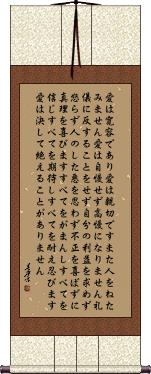
Here is 1st Corinthians 13:4-8 (just the first sentence of verse 8) in Japanese.
In the familiar NIV, this would read:
Love is patient, love is kind. It does not envy, it does not boast, it is not proud.
It does not dishonor others, it is not self-seeking, it is not easily angered, it keeps no record of wrongs.
Love does not delight in evil but rejoices with the truth.
It always protects, always trusts, always hopes, always perseveres.
Love never fails...
The Japanese text is from the 新改訳聖書 (Shinkaiyaku) or New Japanese Bible. Popular among most Protestant denominations in modern Japan.
Note: Because this selection contains some special Japanese Hiragana characters, it should be written by a Japanese calligrapher.
Corinthians 13:4
All you need to know about LOVE
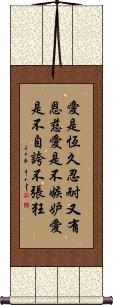
愛是恆久忍耐又有恩慈愛是不嫉妒愛是不自誇不張狂 is 1st Corinthians 13:4 in Chinese.
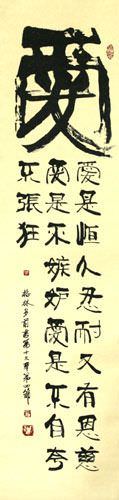
With large “love” character added.
In English, this reads:
1st Corinthians 13:4 (KJV) Charity suffereth long, and is kind; charity envieth not; charity vaunteth not itself, is not puffed up...
1st Corinthians 13:4 (NIV) Love is patient, love is kind. It does not envy, it does not boast, it is not proud.
1st Corinthians 13:4 (Basic English) Love is never tired of waiting; love is kind; love has no envy; love has no high opinion of itself, love has no pride.
The Chinese translation follows the love meaning, rather than the King James' use of “charity.” I was a little confused when writing this description with the significant differences between the NIV vs. KJV translations. After speaking to a Greek scholar about this, it would seem that the KJV has an almost errant translation with the use of “charity” in place of “love.”
We used the most popular Christian Chinese Bible, which is the Chinese Union Version (CUV). The CUV was first published in 1919. We use this so that the Chinese translation would be as accurate and standard as possible. Any Chinese Christian worth their salt will easily be able to identify this verse when they see these characters.
If you want a big “love” character written above the verse on your artwork, just make a note in the “special instructions” tab when you are customizing your artwork. There is no extra charge for that service on this special verse.
Corinthians 13:4

愛は忍耐強い。愛は情け深い。ねたまない。愛は自慢せず、高ぶらない。is 1st Corinthians 13:4 in Japanese.
In English, this reads:
1st Corinthians 13:4 (KJV) Charity suffereth long, and is kind; charity envieth not; charity vaunteth not itself, is not puffed up...
1st Corinthians 13:4 (NIV) Love is patient, love is kind. It does not envy, it does not boast, it is not proud.
1st Corinthians 13:4 (Basic English) Love is never tired of waiting; love is kind; love has no envy; love has no high opinion of itself, love has no pride.
If you want a big “love” character written above the verse on your artwork, just make a note in the “special instructions” tab when you are customizing your artwork. There is no extra charge for that service on this special verse.
Note: Because this selection contains some special Japanese Hiragana characters, it should be written by a Japanese calligrapher.
Gaman
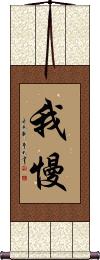
Gaman is a Zen Buddhist term from Japan that means “enduring the seemingly unbearable with patience and dignity.”
This title can also be translated as patience, perseverance, tolerance, or self-denial.
我慢 is also a Chinese Buddhist term with a different pronunciation. It comes from Sanskrit abhimāna or ātma-mada. Chinese Buddhism defines this very differently as “Egoism exalting self and depreciating others,” “self-intoxication,” or “pride.” Alone, the first character means “Me, I, or Self,” and the second character in a Buddhist context comes from Sanskrit māna and means pride, arrogance, self-conceit, looking down on others, superciliousness, etc.
I’m currently working with Japanese and Chinese translators to try and reconcile the true meaning or any commonality of this word between languages. For now, please only consider this if your audience is Japanese.
Ninja
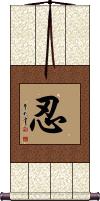
忍 is just the first character of “Ninja.”
It means to beat, to endure, or to tolerate.
Some use this as the short form of “Ninja” but it would be more correct to use the two-character version in most cases (and for clarity). Other definitions of this Kanji include: to bear, put up with, conceal, spy, or sneak. It is also a character in Korean Hanja and Chinese but not well-known with this meaning but rather a definition like “patience.” Note that when writing this as Kanji, Japanese will tend to write it in the form shown to the right. If you select our Japanese master calligrapher, please expect this Kanji form (yes, it's just one stroke that is slightly different in location, crossing another stroke in the Japanese Kanji form).
Ninpo
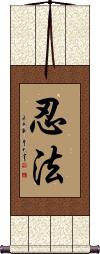
忍法 is Ninpo which can be translated as “Ninja Arts” from Japanese.
If you want this to mean “Ninja Arts,” you should consider this to be Japanese only. In Chinese, someone might read this as “patience law” or “the art of patience.”
The first character can be associated with “Ninja” since it is the “Nin” of “Ninja.” But the literal meaning is patience or perseverance. The second character means “law” or “method.” Often this is extended to mean or be translated as “arts.”
Within a Buddhist context (especially Chinese Buddhism), this is the method or stage of patience, the sixth of the seven stages of the Hīnayāna in the attainment of arhatship, or sainthood.
One frost doesn't make winter

一次霜凍不代表整個冬天 is a proverb that means “One frost doesn't make winter.”
The deeper meaning is that a single early sign of cold weather doesn't signify the full onset or severity of winter; it's about the gradual transition of seasons, patience, and not jumping to conclusions.
It's a reminder to stay resilient, wait for the real season to arrive, and not let one small event define the whole experience, similar to how one kind word can warm you for months.
While the origin of this proverb is murky (not originally Chinese, likely a modern adaptation of “One swallow does not a summer make”), this idea aligns with the Chinese solar terms (二十四節氣), which mark subtle shifts, like the transition from "cold dew" (寒露) to "frost falls" (霜降).
Osu No Seishin
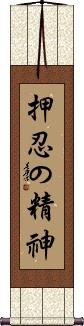
押忍の精神 is the name Osu No Seishin or “Spirit of Osu” in Japanese.
This Spirit of Osu is an essential concept in Karate. You will hear “Osu!” shouted in every Karate dojo which is not just a sign of respect and obedience to the Sensei but also means patience, determination, and perseverance. Shouting “Osu!” serves as a reminder to embody these qualities.
Patience Brings Peace of Mind
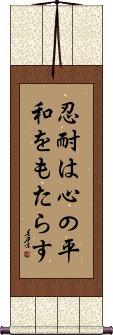
忍耐は心の平和をもたらす means “patience brings peace of mind,” in Japanese.
Note: Because this selection contains some special Japanese Hiragana characters, it should be written by a Japanese calligrapher.
Patience Yields Peace of Mind
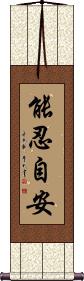
This ancient Chinese proverb can be translated as “Patience brings peace of mind,” “One who has patience finds peace,” and a few other ways.
Patience / Perseverance
忍 contains the ideas of patience, equanimity, perseverance, forbearance, and endurance. Alone, this single character can be a bit ambiguous or flexible. It can also mean to endure, to bear, to put up with, or to conceal. If you want to simply decide what this character means to you within the general meaning but keep it a mystery to others, this is a good choice.
If you want to be more direct, you may want to choose one of our other selections that mean perseverance or patience (you will see this character within those larger words/phrases).
There is a secondary meaning in Japanese since this is the first character of the word ninja.Note that when writing this as Kanji, Japanese will tend to write it in the form shown to the right. If you select our Japanese master calligrapher, please expect this Kanji form (yes, it's just one stroke that is slightly different in location, crossing another stroke in the Japanese Kanji form).
See Also: Perseverance | Tenacious
Patience / Perseverance / To Endure / Tolerant
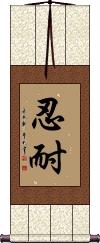
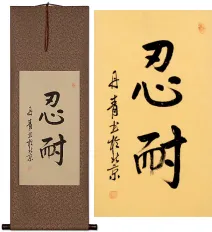
忍耐 is patience, the quiet hope, and trust that things will turn out right.
You wait without complaining. You are tolerant and accepting of difficulties and mistakes. You picture the end in the beginning and persevere to meet your goals.
忍耐 can also mean “to endure,” “restrain oneself,” or “forbearance,” and in some contexts, it can mean “perseverance” or “endurance.”
忍耐 is also used as a tenet of Taekwondo, Tang Soo Do, and other Korean martial arts where it's titled “Endurance” and romanized as “In Neh.”
Note that when writing this as Kanji, Japanese will tend to write the first character in the form shown to the right. If you select our Japanese master calligrapher, please expect this Kanji form (yes,
it’s
just one stroke that is slightly different in location, crossing another stroke in the Japanese Kanji form).
See Also: Peace | Harmony | Perseverance
Do not take action until the time is right
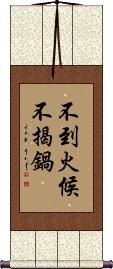
不到火候不揭锅 translates as: Don't take the lid off the pot until the food is done.
Figuratively, this means: Don't take action until the time is right.
You can take this as a call to be patient or pick just the right time to do something (not too early, not too late).
Patience and Preparation

忍耐準備 can be translated as “Perseverance/Endurance and Readiness,” or “Patience and Preparation.”
Peace / Harmony
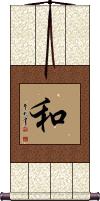
和 is the simplest form of peace and harmony.
和 can also be translated as the peaceful ideas of gentle, mild, kind, and calm. With a more harmonious context, it can be translated as union, together with, on good terms with, or on friendly terms.
Most people would just translate this character as peace and/or harmony. 和 is a very popular character in Asian cultures - you can even call it the “peace symbol” of Asia. In fact, this peace and harmony character was seen repeatedly during the opening ceremony of the 2008 Olympic Games in Beijing (a major theme of the games).
In old Chinese poems and literature, you might see this used as a kind of "and." As in two things summed together. As much as you could say, "the sun and moon," you could say "the sun in harmony with the moon."
See Also: Inner Peace | Simplicity
Stamina / Endurance
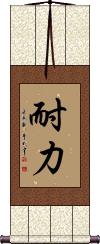
耐力 means stamina or endurance. However, depending on the context, it can also mean patience or tolerance.
耐力 is the first part of titles like “endurance swimming.”
The first character means “to tolerate” or “to endure.”
The second character is “power.”
Together, you could say this word means “the power to endure.”
Taekwondo Tenets / Spirit of Taekwon-do
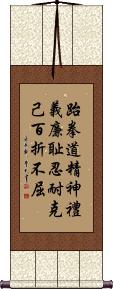
跆拳道精神禮義廉耻忍耐克己百折不屈 is General Choi's writing that is often called “The Tenets of Taekwon-do.”
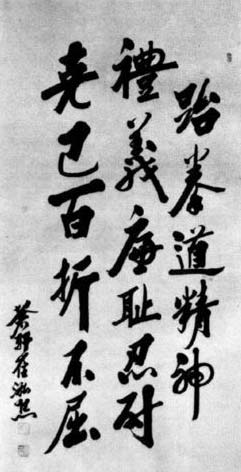
The actual title would be translated as “Taekwondo Spirit” or “The Spirit of Taekwondo.” It was originally written in Korean Hanja (Chinese characters used in Korea for about 1600 years).
General Choi's original calligraphy is shown to the right. Your custom calligraphy will be unique, and not an exact match, as each calligrapher has their own style.In modern times, the common form of written Korean is Hangul (a phonetic character set). The table below shows the text in Hangul and Hanja along with a pronunciation guide and a brief English translation:
| Traditional Korean Hanja | Modern Korean Hangul | Pronunciation | English |
| 跆拳道精神 | 태권도정신 | tae gweon do jeong sin | Taekwondo Spirit |
| 禮儀 | 예의 | ye yi | Courtesy / Etiquette / Propriety / Decorum / Formality |
| 廉耻 | 염치 | yeom ci | Integrity / Sense of Honor |
| 忍耐 | 인내 | in nae | Patience / Perseverance / Endurance |
| 克己 | 극기 | geug gi | Self-Control / Self-Denial / Self-Abnegation |
| 百折不屈 | 백절불굴 | baeg jeor bur gur | Indomitable Spirit (Undaunted even after repeated attacks from the opponent) |
| Note that the pronunciation is the official version now used in South Korea. However, it is different than what you may be used to. For instance, “Taekwon-do” is “tae gweon do.” This new romanization is supposed to be closer to actual Korean pronunciation. | |||
Tolerance
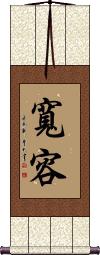
Being tolerant is accepting differences. You don't expect others to think, look, speak or act just like you. You are free of prejudice, knowing that all people have feelings, needs, hopes, and dreams. Tolerance is also accepting things you wish were different with patience and flexibility.
寬容 can also be translated as magnanimity, generosity, or leniency.
Note: There is a tiny deviation in the first character when written in Japanese. If you choose our Japanese master calligrapher, the little dot on the lower right of the first character will be omitted. With or without the dot, this can be read in Chinese, Japanese, and old Korean.
Monkey
Year of the Monkey / Zodiac Sign
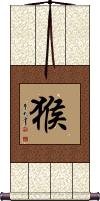
猴 is the monkey character in Chinese.
猴 means ape in Japanese due to an error made long ago as Japan absorbed Chinese characters.
If you were born in the year of the monkey, you . . .
Are smart, brave, active, and competitive.
Like new things.
Have a good memory.
Are quick to respond
Have an easy time winning people's trust.
Are, however, not very patient.
See also our Chinese Zodiac page.
Note: This character does have the meaning of monkey in Korean Hanja but is not used very often.
This in-stock artwork might be what you are looking for, and ships right away...


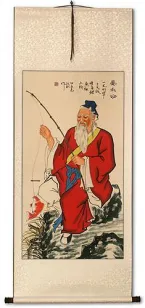

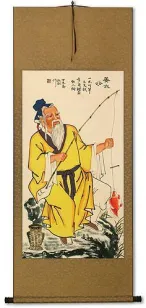
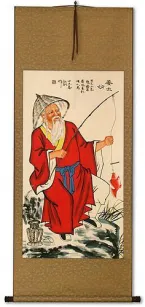
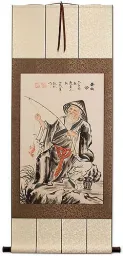
The following table may be helpful for those studying Chinese or Japanese...
| Title | Characters | Romaji (Romanized Japanese) | Various forms of Romanized Chinese | |
| 1 Corinthians 13:4-8 | 愛は寛容であり愛は親切ですまた人をねたみません愛は自慢せず高慢になりません礼儀に反することをせず自分の利益を求めず怒らず人のした悪を思わず不正を喜ばずに真理を喜びますすべてをがまんしすべてを信じすべてを期待しすべてを耐え忍びます愛は決して絶えることがありません | ai wa kan youdeari ai wa shinsetsudesu mata hito o netamimasen ai wa jiman sezu kouman ni narimasen reigi ni hansuru koto o sezu jibun no rieki o motomezu okorazu hito no shita aku o omowazu fusei o yorokobazu ni shinri o yorokobimasu subete o gaman shi s ai wa kan yodeari ai wa shinsetsudesu mata hito o netamimasen ai wa jiman sezu koman ni narimasen reigi ni hansuru koto o sezu jibun no rieki o motomezu okorazu hito no shita aku o omowazu fusei o yorokobazu ni shinri o yorokobimasu subete o gaman shi s | ||
| Corinthians 13:4 | 愛是恆久忍耐又有恩慈愛是不嫉妒愛是不自誇不張狂 爱是恒久忍耐又有恩慈爱是不嫉妒爱是不自夸不张狂 | ài shì héng jiǔ rěn nài yòu yǒu én cí ài shì bú jì dù ài shì bú zì kuā bù zhāng kuáng ai4 shi4 heng2 jiu3 ren3 nai4 you4 you3 en2 ci2 ai4 shi4 bu2 ji4 du4 ai4 shi4 bu2 zi4 kua1 bu4 zhang1 kuang2 ai shi heng jiu ren nai you you en ci ai shi bu ji du ai shi bu zi kua bu zhang kuang | ai shih heng chiu jen nai yu yu en tz`u ai shih pu chi tu ai shih pu tzu k`ua pu chang k`uang ai shih heng chiu jen nai yu yu en tzu ai shih pu chi tu ai shih pu tzu kua pu chang kuang |
|
| Corinthians 13:4 | 愛は忍耐強い。愛は情け深い。ねたまない。愛は自慢せず、高ぶらない。 | ai ha nintai tsuyoi. ai ha nasakebukai. netama nai. ai ha jiman se zu, takabura nai. | ||
| Gaman | 我慢 | ga man / gaman | wǒ màn / wo3 man4 / wo man / woman | |
| Ninja | 忍 | nin | rěn / ren3 / ren | jen |
| Ninpo | 忍法 | nin pou / ninpou / nin po | rěn fǎ / ren3 fa3 / ren fa / renfa | jen fa / jenfa |
| One frost doesn't make winter | 一次霜凍不代表整個冬天 一次霜冻不代表整个冬天 | yī cì shuāng dòng bù dài biǎo zhěng gè dōng tiān yi1 ci4 shuang1 dong4 bu4 dai4 biao3 zheng3 ge4 dong1 tian1 yi ci shuang dong bu dai biao zheng ge dong tian | i tz`u shuang tung pu tai piao cheng ko tung t`ien i tzu shuang tung pu tai piao cheng ko tung tien |
|
| Osu No Seishin | 押忍の精神 | o su no sei shin osunoseishin | ||
| Patience Brings Peace of Mind | 忍耐は心の平和をもたらす | nintai wa kokoro no heiwa o motarasu | ||
| Patience Yields Peace of Mind | 能忍自安 | néng rěn zì ān neng2 ren3 zi4 an1 neng ren zi an nengrenzian | neng jen tzu an nengjentzuan |
|
| Patience Perseverance | 忍 | nin | rěn / ren3 / ren | jen |
| Patience Perseverance To Endure Tolerant | 忍耐 | nin tai / nintai | rěn nài / ren3 nai4 / ren nai / rennai | jen nai / jennai |
| Do not take action until the time is right | 不到火候不揭鍋 不到火候不揭锅 | bù dào huǒ hou bù jiē guō bu4 dao4 huo3 hou bu4 jie1 guo1 bu dao huo hou bu jie guo budaohuohoubujieguo | pu tao huo hou pu chieh kuo putaohuohoupuchiehkuo |
|
| Patience and Preparation | 忍耐準備 | nin tai jun bi nintaijunbi | rěn nài zhǔn bèi ren3 nai4 zhun3 bei4 ren nai zhun bei rennaizhunbei | jen nai chun pei jennaichunpei |
| Peace Harmony | 和 | wa | hé / he2 / he | ho |
| Stamina Endurance | 耐力 | nài lì / nai4 li4 / nai li / naili | ||
| Taekwondo Tenets Spirit of Taekwon-do | 跆拳道精神禮義廉耻忍耐克己百折不屈 跆拳道精神礼义廉耻忍耐克己百折不屈 | tái quán dào jīng shén lǐ yì lián chǐ rěn nài kè jǐ bǎi zhé bù qū tai2 quan2 dao4 jing1 shen2 li3 yi4 lian2 chi3 ren3 nai4 ke4 ji3 bai3 zhe2 bu4 qu1 tai quan dao jing shen li yi lian chi ren nai ke ji bai zhe bu qu | t`ai ch`üan tao ching shen li i lien ch`ih jen nai k`o chi pai che pu ch`ü tai chüan tao ching shen li i lien chih jen nai ko chi pai che pu chü |
|
| Tolerance | 寬容 宽容 | kanyou / kanyo | kuān róng kuan1 rong2 kuan rong kuanrong | k`uan jung kuanjung kuan jung |
| Monkey | 猴 | hóu / hou2 / hou | ||
| In some entries above you will see that characters have different versions above and below a line. In these cases, the characters above the line are Traditional Chinese, while the ones below are Simplified Chinese. | ||||



